
The Net485-MB has two choices for the Connect Protocol.
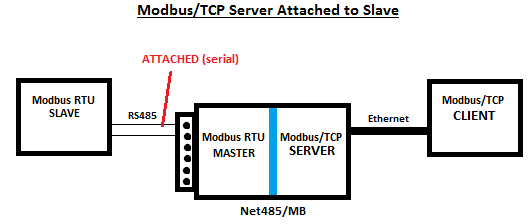
Modbus/TCP Server Attached to Slave
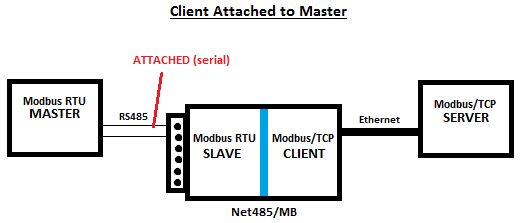
Modbus/TCP Client Attached to Master
These decide how the Net485-MB will behave in regards to the RS485 and TCP relationships of your equipment.
Serial and TCP applications use different terminology for the Modbus components. For TCP it is Client/Server and for Serial it is Master/Slave.
Modbus/TCP Client = Modbus RTU Master
Modbus/TCP Server = Modbus RTU Slave
These roles must be maintained for communication and cannot operate independently of each other. A Client must connect to a Server, and a Master can only talk to a Slave.
These are significant in the application because we are presented with the problem of a TCP/Client needing to query an RTU Slave, or an RTU Master needing to communicate with a TCP/Server. For this, the Net485-MB will assume two roles.
In the Connect Protocols, the TCP designation is the Modbus/TCP role of the Net485 itself, and the "Attached" device refers to the unit connected over the Serial connection.
Modbus/TCP Server attached to Slave - Used when a Modbus/TCP Client needs to communicate with an RTU Slave.The Net485-MB will operate as a TCP Server AND a Modbus RTU Master, relaying the data to the Attached Slave device.
Modbus/TCP Client attached to Master - Used when a Modbus RTU Master needs to communicate with a Modbus/TCP Server. The Net485-MB will act as a Modbus/TCP Client AND a Modbus RTU Slave. This application will require filling out the Unit ID to IP Address mapping table. This will guide the queries from the master to the correct Server by linking the Unit ID (Slave Address) to the desired IP address.
Comments
0 comments
Please sign in to leave a comment.